

Bismillah Al-Raḥmān Al-Raḥīm; Ṣallā Allahu `alā Sayyadinā Muḥammad wa `alā Ālihi wa Ṣaḥbihi wa Sallam — In the Name of God, Most Merciful and Compassionate; God’s Blessings and Peace be upon our Master, Muḥammad, and on his Family and Companions.
We are obsessed with finding our place and eventual success in a system that was not designed for us to succeed as we are, only as they imagined we should be. After centuries of intensely horrific and dehumanizing oppression by a civilizational system that sought only to dominate, exploit, and control the people and resources outside of their ethnic groups and geographical locations, we have reached a point where their past efforts are now bearing the most value.
There is a reason so much of the discourse we currently hear in modern Western societies is directed towards the preservation of, assimilation to, and embracing of Western culture, norms, and so-called values. While there is an acknowledged “awakening” among people around the world who were firsthand recipients of the gross oppression and destruction, there is also a level of silent capitulation to the system and tools that have been developed and used over the centuries, and a belief that borders on religious conviction, that centers on their supposed superiority.
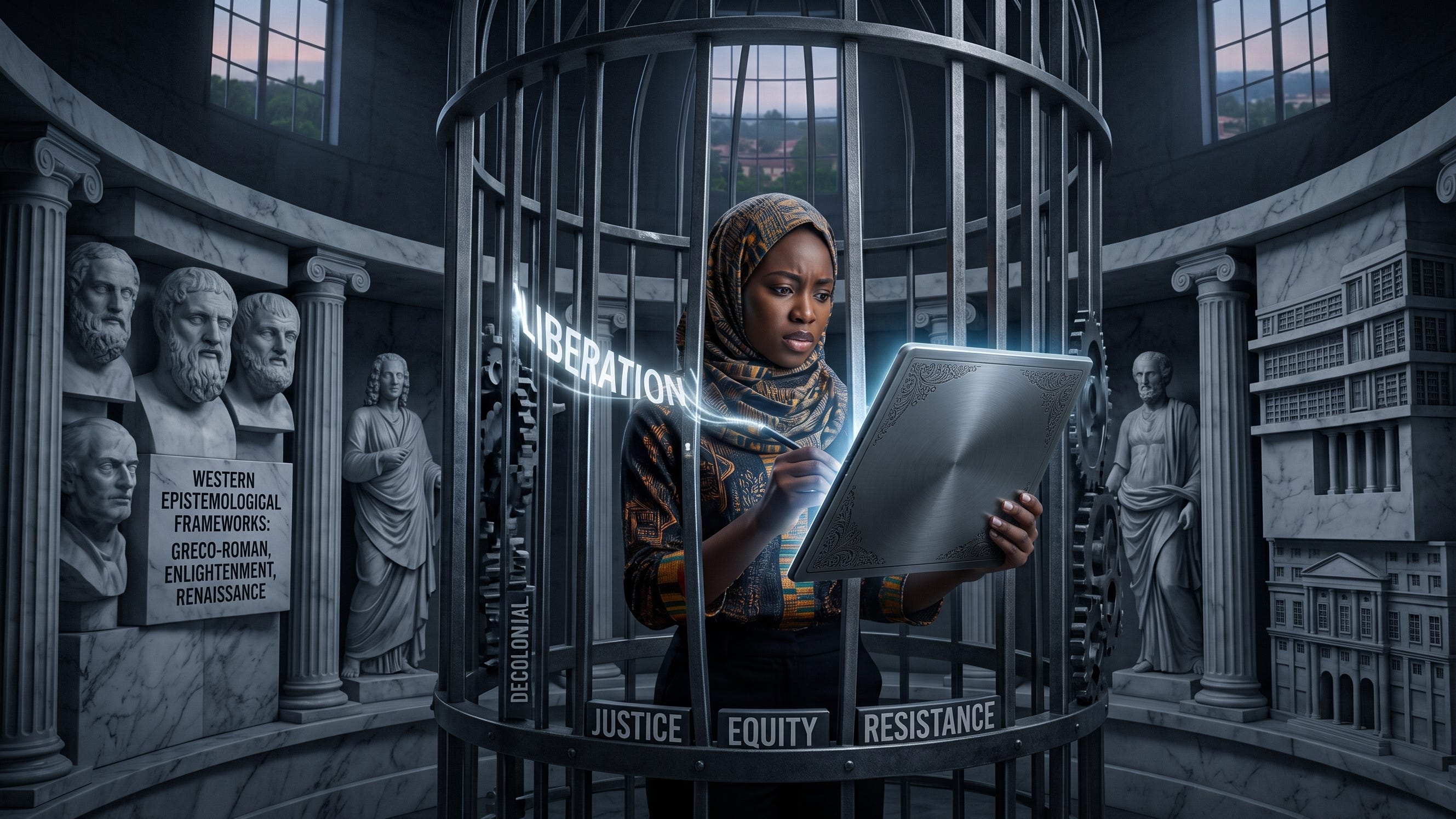
If you want to succeed in business, you must embrace usury. If you wish to be considered beautiful and valuable, you must show your body and forego the joy and dignity of modesty, family, and marriage. If you want to be counted among the intelligent and astute, you must abandon all knowledge, ways of learning, and worldviews that do not elevate the Greco-Roman tradition, the European Enlightenment, the Renaissance period, and all of its subsequent manifestations, as the only way to engage with and understand creation.
Even in our so-called rejection of Western imperialism, we frame our discussion in the language of decolonialism or some form of liberation theology that, in both their form and substance, are products of the same Western ideology and frameworks we are claiming to reject.
Notwithstanding the fact that the rejection of Western superiority is valid for a plethora of reasons, stated and unstated, we have failed to name and discuss this endemic plague in any meaningful way that fully uses an epistemological framing that is not subsumed by and beholden to what the Western academy has given us to use.
As discussed in my last article, this week, I am sharing the first framework from my 3-Framework Architecture, Captive Opposition.1
Captive Opposition is a diagnostic framework that identifies the multitudinous structural conditions that hold all academic, political, financial, sociological, etc., forms of resistance by the aforementioned groups captive to the Western world’s epistemological, sociological, financial, political, and institutional infrastructures & frameworks.
As a result of being held captive, one is unable to recognize the problem or think and operate outside of the complete embrace of the Western world’s sphere of influence and validation, despite staunch opposition to it.
To be clear, I am not saying that because something originates in, or is upheld as the way forward by, Western society, it is completely useless and must be abandoned without any second thought. This type of thinking and behavior is a sign of a person’s ignorance and inability to lead a nation or group of people anywhere near success.
The Messenger of Allah ﷺ reminds us in the following ḥadīth,
Narrated Abu Hurairah, that the Messenger of Allah ﷺ said: The wise statement is the lost property of the believer, so wherever he finds it, then he is more worthy of it. (Tirmidhī 2687)2
What I am saying is that engagement with the West, particularly for Muslims, African Americans, and all oppressed and marginalized people, has to be on much more honorable and equitable terms and conditions. We need our own systems of government, finance, cultural & social standards that support our engagement with the West through our own institutions, frameworks, and support systems.
For the better part of the last half of a millennium, with an increased level of intensity for the last 250 years, Western “civilization” has been rabidly focused on the complete domination and subjugation of everyone and everything outside of Europe. The result of this quest has been a horrific and sordid history of rape, murder, genocide, and every other type of foul injustice and oppression humans have witnessed throughout history.
Far more historically engaged people have discussed these phases of human history; I will not attempt to narrate details of the historical record. I will share what we all know has been the outcome of this quest of Western civilization. The complete disfiguring, dismantling and destruction of our institutional memory of how we governed ourselves and thrived before the arrival of the Europeans to many of the lands they pillaged and transformed into caricatures of the different European countries that each oppressor represented.
I am not making this a rant; rather, I am raising this history of oppression to center our problems and concerns while redirecting the conversation to its solution. A considerable portion of my work and research is committed to countering this problem and doing so in a way that provides Muslims, African Americans, and all other marginalized and oppressed people, be they scholars, academics, politicians, etc., with tools and terminology that are truly free from all foreign and oppressive influences.
Now that I have given you a glimpse of the diagnostic framework, the next framework I will share is the constructive one, Khidmiyya. This framework is the pillar around which and through which all of my work and research will revolve, InShā’Allah. While it is the centerpiece of my thesis & research and I have formulated it as a field of practical theology, it is designed and envisioned to serve a much broader purpose and mission.
Khidmiyya will be followed by Reasoned Perspectives, my pedagogical & prescriptive framework designed and presented as a course. I will be opening up the first cohort to present this opportunity in two formats. One will be a public (general enrollment) course offering and a closed (limited enrollment) format where I will be taking on a small group of serious students who will accompany me on an 18-month to 2-year journey3 to be fully immersed in the complete vision and be a part of building out the model for community and institution building that the combined frameworks support.
InShā’Allah, you will have patience with me as I continue to share my thoughts and work.
This, along with the other frameworks I am sharing through this introductory series, is actively being developed as I continue my doctoral program and thesis writing. Much of what I share is based on my most recent line of thinking. I look forward to engaging with a wide range of people and perspectives to finalize my thoughts and ensure the final product is ready to be shared.
This ḥadīth is known to be weak (ḍaʿīf), not fabricated, but the scholars agree that the meaning is sound. Some of my teachers say it is mainly due to a narrator that Imām Tirmidhī identified, who was not accepted due to his weak memory.
This immersion opportunity will involve a structured study of the Farḍ al-ʿAyn (individually obligatory knowledge) each person should know, coupled with a deeply structured and intimate engagement with my frameworks that will allow the students to take what they have learned and use it to advance the vision and work of building the institutions, communities, and people required for human liberation.